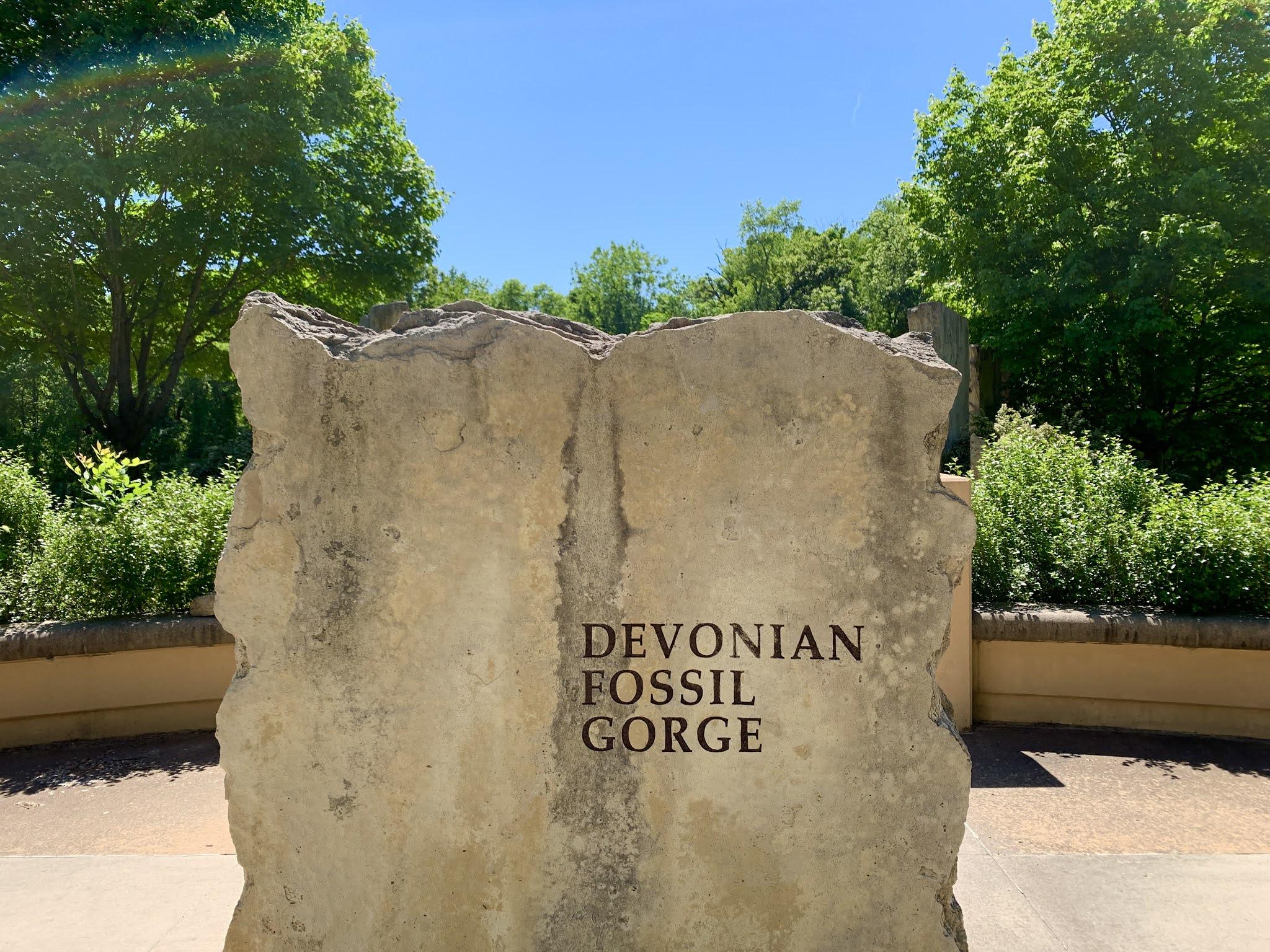
Devonian Fossil Gorge Fossil Hunting Guide
Image: Iowa Kid Adventures
The Devonian Fossil Gorge below the Coralville Lake spillway in Iowa exposes a 375-million-year-old Middle Devonian seafloor, scoured clean by the 1993 and 2008 floods that overtopped the dam. Crinoids, corals, brachiopods, and the occasional fossil fish are visible in-situ on the Cedar Valley Limestone bedrock. Walking access is free, but collecting is prohibited.
The Devonian Fossil Gorge is a flat-bottomed limestone canyon below the emergency spillway of Coralville Lake, just north of Iowa City. It exposes a roughly 375-million-year-old Middle Devonian seafloor of the Cedar Valley Group — bedrock that for most of the past century had been hidden beneath soil, vegetation, and a thin veneer of younger Quaternary sediment. The 1993 Iowa flood overtopped the Coralville Dam's emergency spillway for the first time since the dam was built, and the rushing water stripped away the soil and vegetation below the spillway, exposing the Devonian seafloor in spectacular detail. The 2008 floods overtopped the spillway again and extended and deepened the exposure. The gorge is now managed by the US Army Corps of Engineers as an interpretive geological site with a paved overlook, walking access onto the bedrock, signs, and a virtual-tour partnership with the University of Iowa Paleontology Repository. Collecting is prohibited; visitors observe and photograph the fossils in place.
This guide covers the visit, the fossils visible in-situ, and the geological story that produced both the seafloor and its modern exposure.
Location and Directions
The Devonian Fossil Gorge is on the west side of the Iowa River, immediately below the Coralville Dam emergency spillway. The site is administered by the US Army Corps of Engineers as part of the Coralville Lake recreation complex. From Interstate 80 at Iowa City, take exit 244 (Dubuque Street/US-218) north for about 3 miles, then west on Dubuque Street to the Coralville Lake entrance. From the dam parking area a short walk leads to a paved overlook and stair-and-ramp access down onto the gorge floor.
Visit experience
The gorge floor is roughly the size of a football field and is essentially a flat-lying limestone bedrock surface with interpretive signage in place. Visitors walk directly on the 375-million-year-old seafloor. Fossils are visible in-situ, embedded in the limestone or laid out on the bedding planes exactly where they accumulated when this was the bottom of a shallow tropical sea. The US Army Corps of Engineers and the University of Iowa offer ranger-led tours during the summer months and a self-guided virtual tour year-round. Standard caveats apply: the limestone is uneven and slippery when wet, the area is exposed with no shade, and the gorge is below the spillway, so it is closed if Corps managers anticipate spillway overtopping (rare but possible during major flood events).
What Fossils You'll Find
The bedrock exposed in the gorge is the lower Cedar Valley Group, in particular the Little Cedar Formation, deposited about 387 to 382 million years ago during the Middle Devonian (Givetian) on the broad, shallow tropical shelf that covered much of mid-continental North America. The fossils are exactly the assemblage you would expect from a Middle Devonian shallow carbonate platform: corals, brachiopods, crinoids, and a smaller number of other invertebrates.
Crinoid columnals are the most ubiquitous fossil at the gorge. Disarticulated stems, individual columnals, and the occasional small crinoid calyx are visible across the bedrock surface; the long stem segments preserved as thin chains of disks are particularly photogenic. Brachiopods of several genera occur as articulated shells lying on their original life position, especially the wide-hinged strophomenids and the smaller rhynchonellids. Corals are the showpiece fossils: large solitary rugose corals (Heliophyllum, Cystiphyllum, and Iowa's state fossil candidate Hexagonaria percarinata — the same coral that, polished by Lake Michigan glacial action, becomes the famous "Petoskey stone") are visible as cross-sections on the bedrock surface, and tabulate corals (Favosites) form pavement-like accumulations in some bedding planes. Cephalopods, both straight nautiloids and the occasional small coiled form, appear as long shell sections on the bedrock. Fossil fish material is rare but documented; placoderm and other Devonian fish remains have been recovered from the broader Cedar Valley succession across Iowa.
"Cedar Valley Group fossils visible at the gorge include Devonian corals (Hexagonaria and Favosites in particular), crinoids and starfish-like animals that looked like plants, and brachiopod shells with their distinctive wide hinges." University of Iowa Paleontology Repository
Geologic History
During the Middle Devonian, the modern Iowa region was located in the tropics on the south side of the closing Iapetus Ocean. The continental interior was flooded by a broad, warm shallow sea — one of the largest of the Phanerozoic — and on that shelf accumulated the thick succession of limestones and dolomites that today underlie much of the Midwest. The Cedar Valley Group preserves the middle of that succession in eastern Iowa, in particular a series of biostromal (sheet-like) coral and stromatoporoid build-ups intercalated with shelly limestones and minor shales. The Little Cedar Formation, the lowest unit of the Cedar Valley Group exposed in the gorge, is famous for its biostrome of rugose and tabulate corals and is the bedrock layer that the floodwaters scoured clean below the Coralville spillway.
The modern landscape over the bedrock is glacial in origin: Quaternary till and outwash mantle most of eastern Iowa, and before 1993 the Devonian bedrock here was not generally exposed. The 1993 flood overtopped the Coralville emergency spillway by about 4.5 feet, and the resulting torrent stripped soil, vegetation, and roughly 15 feet of overburden to expose the bedrock. The 2008 floods deepened the gorge further. The US Army Corps of Engineers, which operates Coralville Lake, decided to leave the exposure in place rather than restore it, and worked with the University of Iowa to develop the area as a public interpretive site.
How the gorge became a fossil site
The Cedar Valley Group has been a workhorse Devonian fossil unit for Iowa paleontologists for more than a century. Most of that collecting took place in active quarries — including the Conklin Quarry near Iowa City, which produced abundant material before it was abandoned. The Devonian Fossil Gorge is unusual because the floor of the gorge is a natural seafloor exposure rather than a quarried face, and the fossils are visible in their original orientation on bedding planes. The 1993 flood and the 2008 redux unintentionally created one of the best in-situ Devonian seafloor exhibits in North America.
Collecting Rules & Regulations
Is Fossil Collecting Allowed?
No. The gorge is a US Army Corps of Engineers interpretive site. Removal of fossils is prohibited.
Key Points:
- Walking on the bedrock is permitted and encouraged.
- Photography is encouraged; commercial photography requires advance permission.
- Removing any fossil, rock, or sediment is prohibited.
- The site is closed during flood-warning periods when the spillway may overtop.
- Limestone surface is slippery when wet; wear non-slip footwear.
Sources
Nearby sites
 Mazon Creek Fossil Hunting GuidePlant Fossils
 Ashfall Fossil Beds State Historical Park Fossil Hunting GuideTeleoceras major (barrel-bodied rhinos), Cormohipparion occidentale (three-toed horses)
 St. Leon Roadcut Fossil Hunting GuideBrachiopods, Bryozoans
 Hueston Woods State Park Fossil Hunting GuideTrilobites, Brachiopods